

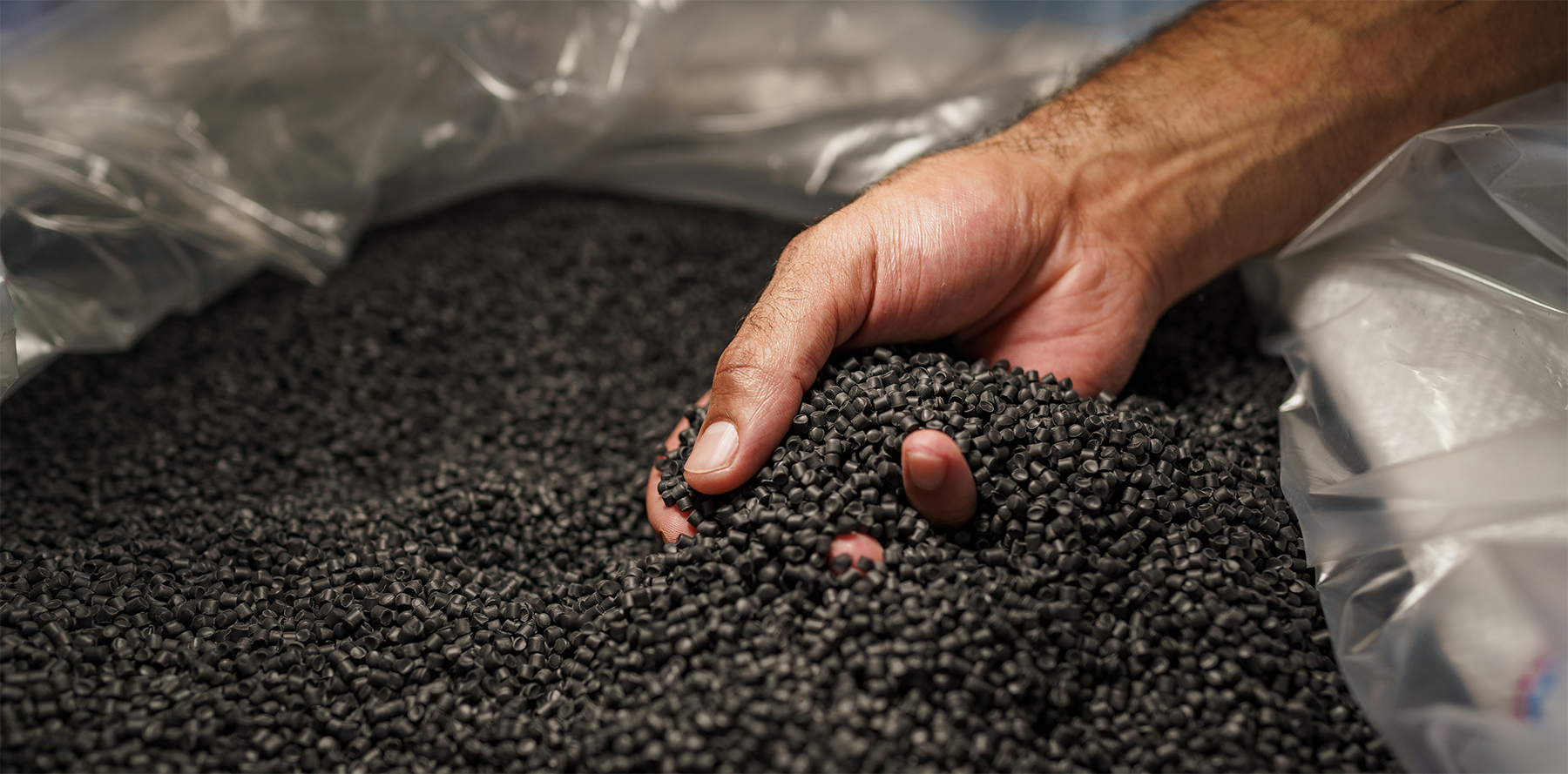
Polyethylene is chemically the simplest polymer. It is represented by its repeating unit (CH₂–CH₂)n. It is the most widely produced plastic in the world, with some 150 million units produced last year. The use of polyethylene in the manufacture of pipes for water conveyance and under pressure (water supply, sewerage and irrigation) is relatively recent, as other materials, such as cast iron or fibre cement, previously dominated hydraulic installations. As it is one of the most widely used polymers for the production of pipes designed to withstand hydraulic pressure, at Caudal we have been committed for over 26 years to transforming polyethylene into high-performance products for agriculture and civil engineering, primarily by adapting the characteristics of the raw material to the uses required by our customers:
MATERIALS
The density of the PE, as determined by the various operating conditions during the polymerisation reaction, will determine the various physical properties attributed to the pipe, such as stiffness, hardness and heat resistance. As density increases, so do hardness and stiffness:
High-density polyethylene, HDPE (High Density Polyethylene)
Its density ranges from 0.941 to 0.960 g/cm³; it is a type of material that is more resistant to mechanical tensile stress than medium- and low-density polyethylene, although it is less flexible. Good examples are PE 100 and PE 80, both of which are highly resistant to chemicals such as acids, solvents, etc. PE 100 can be used for agricultural or food applications, whilst PE 80 is intended solely for agricultural use. Another of its main characteristics is its ability to withstand high pressures and high temperatures of up to 90–100 °C. In both cases, these products are 100 per cent recyclable.
Medium-density polyethylene, MDPE (Medium Density Polyethylene).
This material has a density of between 0.930 and 0.940 g/cm³, representing a balance between high- and low-density polyethylene. Designed to withstand an average pressure of 6 bar, these materials are highly resistant to chemicals and cracking, even more so than their ‘big brother’, HDPE. A good example of this is our PE 63 for agricultural use. It is, of course, a 100% recyclable product. For further information, download the PE 63 technical data sheet here.
Low-density polyethylene (LDPE).
As its name suggests, it is a material with a lower density of between 0.910 and 0.929 g/cm³; although it possesses some very interesting properties, it is the undisputed champion of flexibility. Designed to withstand pressures of between 4 and 10 bar, it is undoubtedly a lightweight and easy-to-handle material. PE 40 is a versatile option for both agricultural and food applications; it is highly resistant to cracking and 100 per cent recyclable. Find out more about PE 40.
SOME APPLICATIONS
Our PE pipes for pressurised water supply offer optimal solutions for:
FOOD-GRADE PIPING
Food-grade pipework is used to convey drinking water. It is primarily used in water supply networks for urban areas and the food industry (drinking water supply networks). These pipes are usually black in colour and feature a blue band, indicating that the material used is suitable for food contact and that they are Aenor-certified or comply with the UNE-ES 12201-2 standard.
AGRICULTURAL PIPING
When selecting agricultural pipework, it is essential to ensure that it is used solely and exclusively for non-potable water systems (irrigation heads, farms, rainwater drainage, etc.), as these pipes are not certified for such use. These pipes are usually black in colour and feature green, brown, white or purple bands, depending on the density of the raw material used.