



Water is essential for plant growth and development. A lack of water can limit crop production, reduce yields and affect product quality.
Irrigation enables farmers to control the water supply and increase production; however, if it is inefficient, it can lead to water wastage, soil salinisation and the pollution of water sources.
What is water efficiency?
Water efficiency in agriculture aims to optimise water use, maximising the amount of water utilised by crops and minimising unnecessary losses. The aim is to make the most of every drop of water in agricultural production, through practices that prevent waste and ensure that plants receive what they need.
Optimising irrigation, improving soil water retention and selecting crops suited to local conditions are practices that enhance both water efficiency and sustainability.
Measuring water use efficiency in crops is essential for optimising water use and ensuring sustainable agricultural production. To this end, we can use various indicators:
How is application efficiency calculated?
Irrigation Efficiency (Ea) is a key indicator that measures the percentage of water applied that is actually available in the crop’s root zone. It helps to determine how efficient an irrigation system is at delivering usable water without wastage.
It is expressed as:
Ea = Water stored in the root zone / Water applied × 100
Where:
- Water stored in the root zone: This is the volume of water remaining in the soil within the profile where plant roots can absorb it.
- Water applied: This is the total amount of water supplied to the field during irrigation.
If water seeps beyond the reach of the roots, it is lost through deep percolation; similarly, land with excessive runoff or uneven distribution results in poor application efficiency.
Application efficiency in drip irrigation
As a guide, for this type of irrigation, the index ranges from 80 to 95 per cent.
We can improve the application’s efficiency by following a few recommendations:
- Plan irrigation correctly according to the crop’s needs and the soil’s water-holding capacity. Develop smart systems.
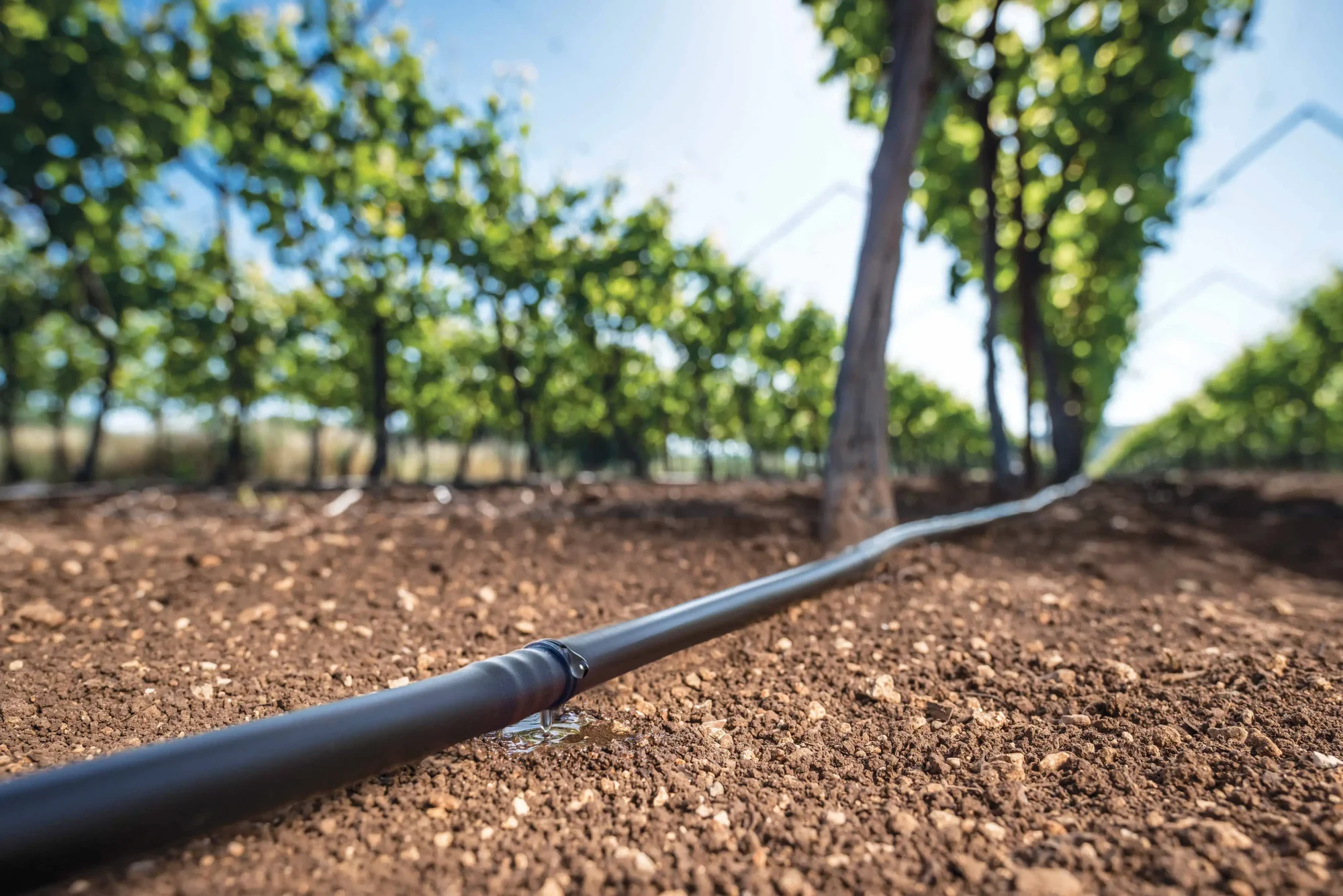
- Use efficient irrigation systems, such as drip irrigation or sprinkler systems with low-evaporation nozzles.
- Keep the system in good condition by checking pipes, emitters and nozzles to prevent leaks and blockages.
How is storage efficiency calculated?
Storage Efficiency (Ee) is an indicator that measures the percentage of water applied during irrigation that is actually stored in the crop’s root zone, compared with the amount of water that the soil could store without incurring losses due to deep percolation.
It is expressed as:
Ee = Water stored in the root zone – Water required to replenish soil moisture × 100
Where:
- Water stored in the root zone: The amount of water that was actually retained in the soil and available to the roots.
- Water required to restore soil moisture: The difference between field capacity and the initial soil moisture level prior to irrigation.
Factors affecting Ee
- Soil texture and structure:
- Sandy soils drain more quickly and may lose water through percolation.
- Clay soils can retain too much water, reducing oxygen supply to the roots.
- Root zone depth: If the amount of water applied exceeds the depth of the roots, it is lost through percolation.
- Frequency and amount of watering: Excessive or infrequent watering can affect efficiency.
- Soil compaction: It reduces the soil’s ability to absorb water and can lead to waterlogging.
Water-use efficiency in drip irrigation
As a guide, in this irrigation system, the storage efficiency index ranges from 80 to 95 per cent.
We can improve this figure by following a few recommendations:
- Apply water according to the soil’s water-holding capacity.
- Avoid over-watering, which can cause deep percolation.
- Ensure the soil is properly prepared to improve its infiltration capacity.
- Adjust the frequency and duration of watering according to the crop’s requirements.
- Use technologies such as moisture sensors to monitor soil water storage.
How is distribution efficiency calculated?
Distribution Efficiency (Ed) in drip irrigation measures the uniformity with which water is distributed through the emitters in the system. An efficient system should deliver similar amounts of water across the entire crop area, minimising differences between plants.
It is expressed as:
Ed = Flow rate of the emitter with the lowest discharge / Average flow rate of all emitters × 100
Where:
- Flow rate of the emitter with the lowest discharge: This is the flow rate of the dripper that delivers the smallest amount of water within the system under assessment.
- Average flow rate of all emitters: This is the average of the flow rate measurements taken at different emitters within the irrigated area.
Factors Affecting Irrigation Efficiency in Drip Irrigation
- Pressure variation: If the pressure varies along the length of the pipe, the emitters furthest away may receive less water. This is particularly important with turbulent drippers and irrigation tape.
- Blockage of emitters: Sediment, algae or salts can block the drippers, reducing their flow.
- Excessive length of the irrigation laterals: this can cause pressure differences between the start and end points.
- Ground slope: differences in elevation affect the pressure exerted on the dripper.
ED Values for Drip Irrigation
- Excellent: ≥ 90%
- Acceptable: 80–90%
- Poor: < 80%
How to Improve Distribution Efficiency in Drip Irrigation:
- Use self-regulating drippers.
- Carry out regular maintenance: flush the pipes to prevent blockages.
- Design the system properly.
- Monitor the pressure using pressure gauges at various points in the system to detect pressure drops.
- Use pressure regulators to maintain a consistent flow rate across all irrigation lines.
- Installation of meters to monitor flow rates.
Selection of Materials Based on Water Efficiency
Calculating the above indices leads us to use materials on our plot such as:
- Soil moisture sensors: Tensiometers, FDR or TDR probes for measuring soil water content.
- Weather stations: To monitor evapotranspiration, temperature and relative humidity.
- Programmers.
- Underground irrigation to reduce evaporation.
- Water flow meters: To monitor the volume of water applied for irrigation.
- Drones and remote sensing: To assess crop water stress using multispectral imagery.
Antonio Hoyas
, Agricultural Engineer