

Discover the three key commitments to achieving sustainability in your irrigation system and improve your environmental impact. Get started today!
The Importance of Sustainability in Irrigation Systems
A farm must be profitable and sustainable. Sustainability ensures the farm’s future and is based on two pillars: economic and environmental.
The resources used in agriculture are scarce and must be treated as such. Agricultural land and water are the main scarce resources we use, and they must be managed efficiently.
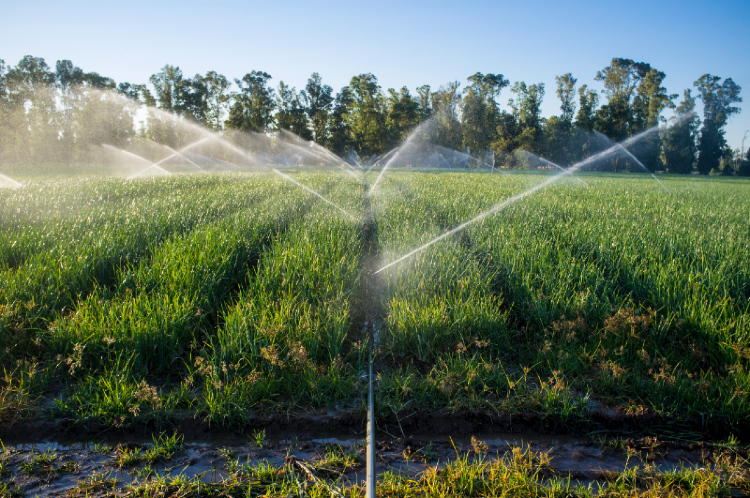
Agriculture is the largest consumer of water, which is why it is up to farmers to improve water use efficiency and make responsible use of every drop of this scarce resource.
Commitment 1 – Optimising water use
The first challenge we must tackle is optimising water use. There are various techniques for optimising water use.
The use of drip irrigation is essential for sustainable irrigation in agriculture.
This irrigation system reduces the amount of water and fertiliser applied, thereby increasing efficiency. The dripper allows water and fertiliser to be applied directly to the plant, reducing water losses caused by evaporation, percolation and run-off, resulting in significant savings in water, fertiliser and energy.
At Caudal, we have a wide range of drippers to suit all the needs farmers may have.
Use of control and automation systems.
By using sensors that measure and record various variables, we can monitor:
- soil moisture,
- soil tension,
- soil electrical conductivity,
- stem diameter,
- fruit size,
- leaf temperature,
- pressure at some point in the hydraulic circuit,
- flow rate passing through a point,
- climate data (air temperature, air humidity, wind speed, wind direction, solar radiation, rainfall),
- PH
- Electrical conductivity of the water (before and after fertilisation), ….
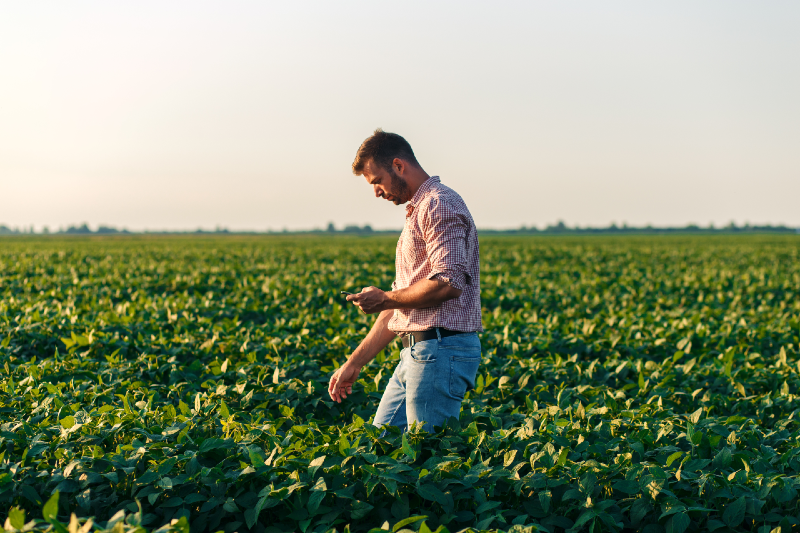
Having access to this data – it doesn’t have to be all of it – recording it and being able to view it makes it easier for us to make decisions and spot any faults. These decisions can be automated, so we know when and how much to water, making irrigation more efficient.
Efficient design of irrigation plots.
Many parameters are required to design an irrigation system correctly.
Firstly, we must take into account the plant, whose potential water consumption will depend on its evapotranspiration (we must assume the most unfavourable scenario, that is, when the plant’s water consumption is at its highest, based on the most unfavourable climatic conditions from the historical data series available to us).
Next, we need to take the soil into account (texture and salinity). From there, we will need to establish a planting plan and decide on the irrigation system to be used. If we were to opt for the most efficient system, which is drip irrigation, we would need to define various parameters (pipe diameter, distance between drippers, flow rate, pipe thickness and type of dripper).
Next, once we know the water availability – both in terms of quantity and the times of day – we will establish the irrigation sectors. Ideally, we should opt for as many sectors as possible, within the limits set by the available hours and the amount of water available. The irrigation sectors must all contain the same crop, at the same stage of growth, and have soil of a similar texture.

Commitment 2 – Reducing Environmental Impact
The second commitment will be to reduce the environmental impact of our agricultural activities.
As well as the water savings and reduced use of fertilisers that drip irrigation systems offer, we should buy pipes that are manufactured in a way that causes the least environmental impact.
At the Caudal Group, we specialise in this area, as the manufacturing process for our pipes involves a series of steps that enable us to achieve this objective:
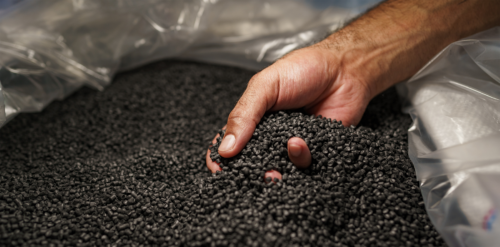
– Our pipes are manufactured from virgin and recyclable raw materials, which can be recycled again, thereby contributing to sustainability.
– In the manufacturing process for our pipes, we use electricity generated by our solar power plant, which is situated next to our factory. The solar installation comprises 3.002 photovoltaic modules spread over an area of 8.392 square metres. With a generation capacity of 1.7 MWp (megawatts peak), it is capable of producing 2.770,254 kWh of clean energy annually.
– In line with their commitment to sustainability and responsible waste management, Extruline Systems S.L. and Caudal and Garden (companies within the Caudal group) have formally joined the Collective Extended Producer Responsibility Scheme (SCRAP) managed by Envalora, thereby complying with Royal Decree 1055/2022, which regulates the management of packaging and packaging waste in Spain.
This legislation, which has been in force since January 2023, sets out new obligations for producers, such as the design of sustainable packaging, the financing of their waste management, registration with the Register of Product Producers (REPRE), and meeting reuse and recycling targets, in line with European directives and the principles of the circular economy.
By joining this scheme, both companies guarantee the proper environmental management of the industrial and commercial packaging they place on the market, ensuring traceability and promoting recycling. They are also reinforcing their commitment to a more efficient, responsible and innovative production model, thereby actively contributing to the protection of the environment.
In addition, we have an integrated quality and environmental management system certified by AENOR and based on the UNE-EN ISO 9001 and UNE-EN ISO 14001 standards.
All of this ensures that anyone buying Caudal pipes can be confident they are manufactured sustainably, but they must also do their bit, as regular maintenance of the irrigation system prevents problems and extends its lifespan.

This preventive maintenance is far better than corrective maintenance, which is carried out once a fault or deficiency has been detected in the system, as the damage caused is sometimes irreparable.
Preventive maintenance involves several aspects:
- water filtration,
- continuous cleaning of the drippers to remove inorganic and organic matter,
- measuring pressures at different points,
- flow measurement…
This maintenance ensures that the irrigation system operates correctly, thereby preventing the wastage of water and fertiliser and reducing the environmental impact of our farming activities.
Commitment 3 – Education and awareness-raising.
The third commitment is to educate and raise awareness amongst farmers of the importance of practising sustainable agriculture. We must realise that those of us who make our living from agriculture are the ones most interested in making it sustainable; to this end, it is important to learn how to practise agriculture in a way that is sustainable from both an environmental and an economic perspective. We must use tools to monitor and automate agricultural activities so that we can make rational use of water resources.