


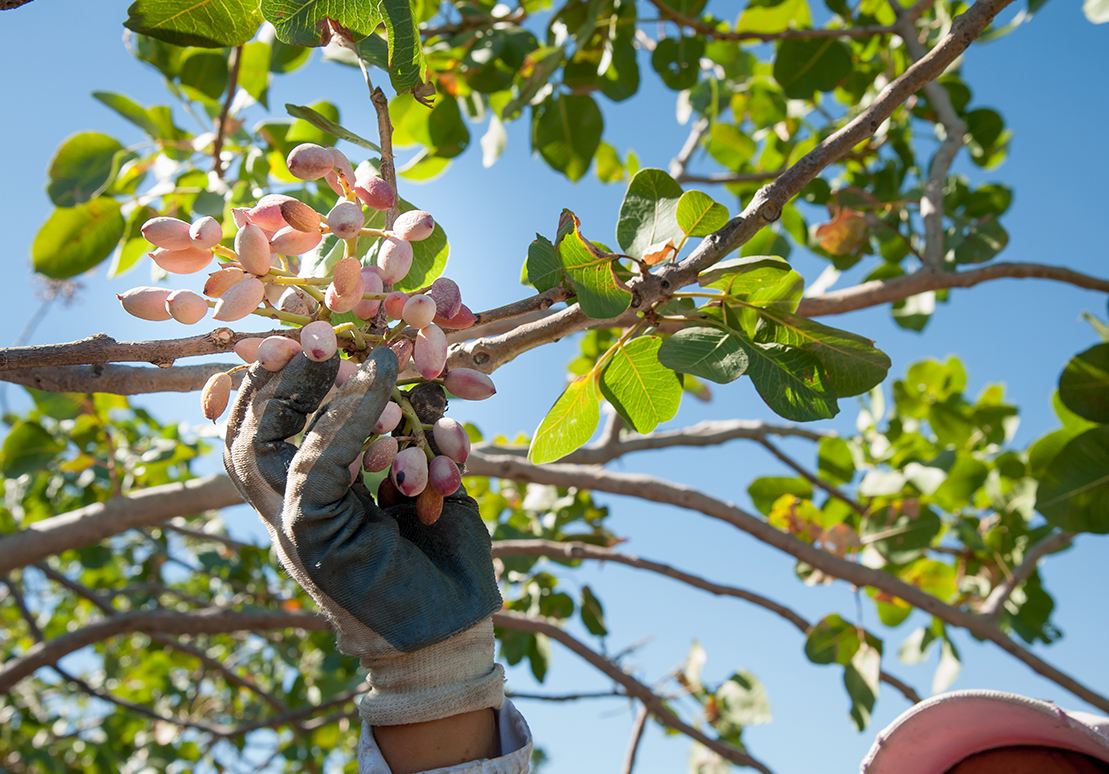
For the past two decades, an increasing number of farmers in Spain have decided to commit to and invest in the cultivation of *Pistacia vera* (the pistachio), with the area under cultivation having increased by as much as 40 per cent in the last ten years alone. It is true that most Spanish plantations are located in the region of Castilla-La Mancha, which represents a promising market for ‘revitalising’ depopulated areas of Spain. Nevertheless, they are also grown in other areas thanks to the adaptability of this plant species.
The pistachio tree adapts very well to arid climates. This makes its cultivation viable in certain areas, as it thrives on plots situated in locations with long, dry summers and cold winters, although prolonged damp conditions are not favourable due to its susceptibility to fungal diseases. It is able to thrive perfectly well on poor and marginal land, where any other crop would struggle. Pistachio trees are frequently found on stony and limestone soils, although loam or sandy loam soils are more favourable.
The minimum water supply required for the crop to be viable must be around 300 L/m² per year. Above this amount, any additional water will improve the plant’s yield and health. Therefore, irrigation for pistachio trees and the chosen irrigation system will depend directly on basic variables such as the plant (age and stage of production), soil type and climate.
Placing even greater emphasis on soil type, it can be said that understanding the soil structure will enable us to determine the most appropriate application of water and nutrients, making use of self-regulating emitters such as Vered or Vardit, which are capable of delivering the same amount of water and nutrients across a wide range of operating pressures. Consequently, both the flow rate and the spacing between emitters must be configured after assessing the percentage of clay, silt and sand in the soil within the top 40 to 50 centimetres. This involves calculating two parameters:
· Field capacity (FC). The maximum capacity of the soil to retain water. Any value exceeding this will cause the soil to drain, resulting in the loss of the excess water that the soil itself has been unable to retain.
· Wilting point (Pm). The minimum amount of water retained in the soil that is absorbed by the plant.
Watering of pistachio trees generally begins in late April and ends in mid-September, with July and August being the months when the most water is applied.
Depending on the amount of water available, irrigation methods can be categorised as follows:
· Intensive irrigation
· Semi-irrigated farming
· Supplementary or deficit irrigation
It is clear that pistachio trees adapt very well to dry areas and can be profitably grown on rain-fed land (250 litres/m²) until they reach their maximum yield on irrigated land with 5.000 m³ per hectare.
But what if we took it a step further?
Given the rise in the cost of water resources, many irrigated pistachio farmers have decided to modernise their facilities to improve efficiency. A clear example of this is those who have opted to install subsurface drip irrigation (SDI) on their plots. This system eliminates evaporation during irrigation, whilst also facilitating the application of fertilisers directly to the root zone, where they are most effective.
To support pistachio growers who wish to upgrade their facilities with the latest technology, Caudal has added, alongside its range of anti-siphon or anti-suction drippers, pipes specially designed for RGS. Our pipes with integrated Rootguard drippers are the only effective root-control solution on the market and also come with a 10-year guarantee.
Please contact us if you would like to find out more about RGS in pistachio cultivation