


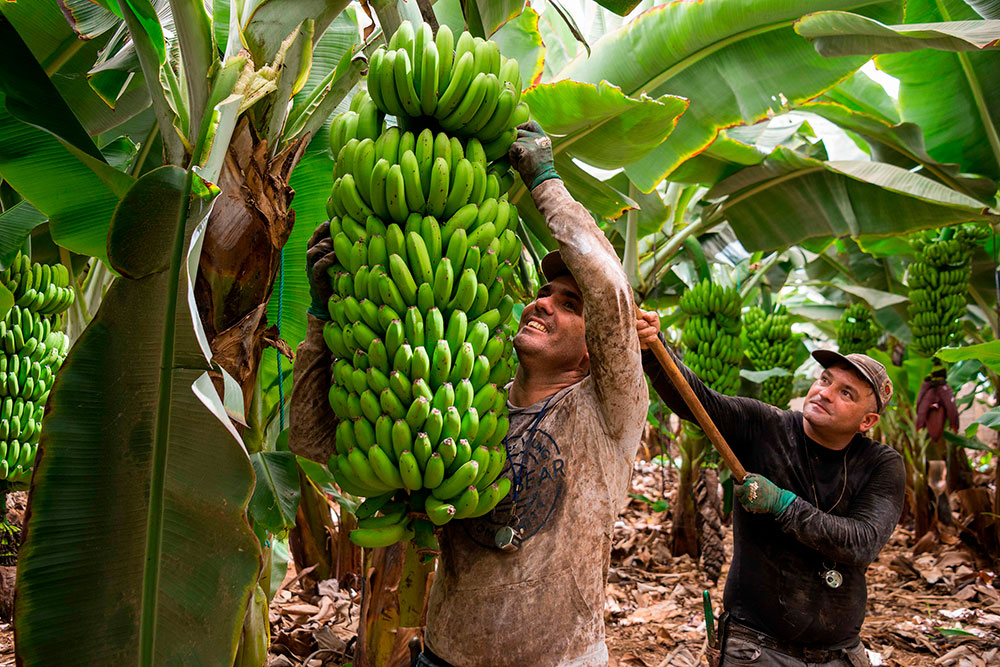
The Canary Island banana is one of the most internationally recognised products our country has to offer. It belongs to a high-quality, flavourful variety of Musa acuminata that is carefully cultivated by hand in the Canary Islands, Spain, and exported to various European countries. Despite its quality, the production and management of this crop face several challenges, including climate change and the threat of diseases such as Fusarium TR4. To tackle these issues, growers are implementing biosecurity measures and using advanced technologies, such as drones and moisture probes, to monitor plant health.
In line with their commitment to sustainability and social responsibility, Canary Islands banana producers have implemented certification programmes through the Association of Canary Islands Banana Producers’ Organisations (ASPROCAN). These programmes ensure fair agricultural practices for workers and local communities, further reinforcing their commitment to sustainability in the production of Canary Islands bananas.
Today we’ll be telling you about the key factors for successfully growing Canary Island bananas, specifically the Cavendish variety, which is the most popular on the islands.
· Soil. The medium in which the plant grows is a key factor in the success of banana cultivation. Bananas grow best in deep, well-drained soil with a loose texture. The soil pH should be between 5.5 and 7, and the soil texture must be loose enough to allow the plant’s roots to grow effectively. Furthermore, the soil must be enriched with nutrients, particularly nitrogen, phosphorus and potassium.
· Variety. Selecting the right plant variety is also a key factor influencing the optimal development of banana plants. In addition to irrigation, fertilisation is essential for banana cultivation. Proper fertilisation can increase the plant’s yield and improve fruit quality. Nitrogen, phosphorus and potassium are the most important nutrients for banana cultivation, and their application must be tailored to the specific needs of the soil and the plant variety.
· Pruning. Pruning the plant is an important practice in banana cultivation. Pruning allows the plant to focus its resources on fruit production by removing non-productive leaves and stems; it can also improve air circulation and sunlight penetration, thereby reducing the risk of disease and improving fruit quality.
· IPM (Integrated Pest Management). Pest and disease control is crucial to the success of banana cultivation. The most common banana diseases are Black Sigatoka and Yellow Sigatoka, both of which are caused by fungi. Integrated pest and disease management may include cultural measures, such as the removal of infected plant debris, as well as the use of fungicides and biocontrol practices.

· Irrigation. Irrigation is a crucial factor in banana cultivation, as an adequate amount of water is necessary for optimal growth and fruit production. However, too much water can be harmful and reduce productivity and fruit quality. It is therefore essential to have an efficient and suitable irrigation system for banana cultivation.
There are several irrigation systems that can be used in banana cultivation, such as sprinkler irrigation, flood irrigation and drip irrigation. Of these, drip irrigation is the most recommended for banana cultivation, as it allows for an efficient supply of water close to the plant’s roots, reducing evaporation and increasing water savings. Furthermore, it can be programmed to supply water constantly and at regular intervals, ensuring that the plants receive the right amount of water.
Drip irrigation is particularly important during the two stages of cultivation: the establishment stage and the production stage. During the establishment stage, a water supply of 2–3 litres per plant per watering is recommended to keep the soil moist and allow a strong root system to develop. During the production stage, a water supply of 3–5 litres per plant per watering is recommended to ensure the soil remains moist and to provide an adequate amount of water for growth and fruit production.

For this reason, choosing the right tools to distribute water and prevent disease is becoming increasingly important. In this regard, Caudal – a company committed to the efficiency and sustainability of its products – offers an optimal solution for your installation: the Super Compact self-compensating pipe. Its cylindrical emitter is fitted with an exceptional turbulent labyrinth, making it an ideal alternative for the use of hard water, agrochemicals and fertilisers on farms with moderate slopes.
Find out how Caudal can help you improve your crops with solutions tailored to your needs!