

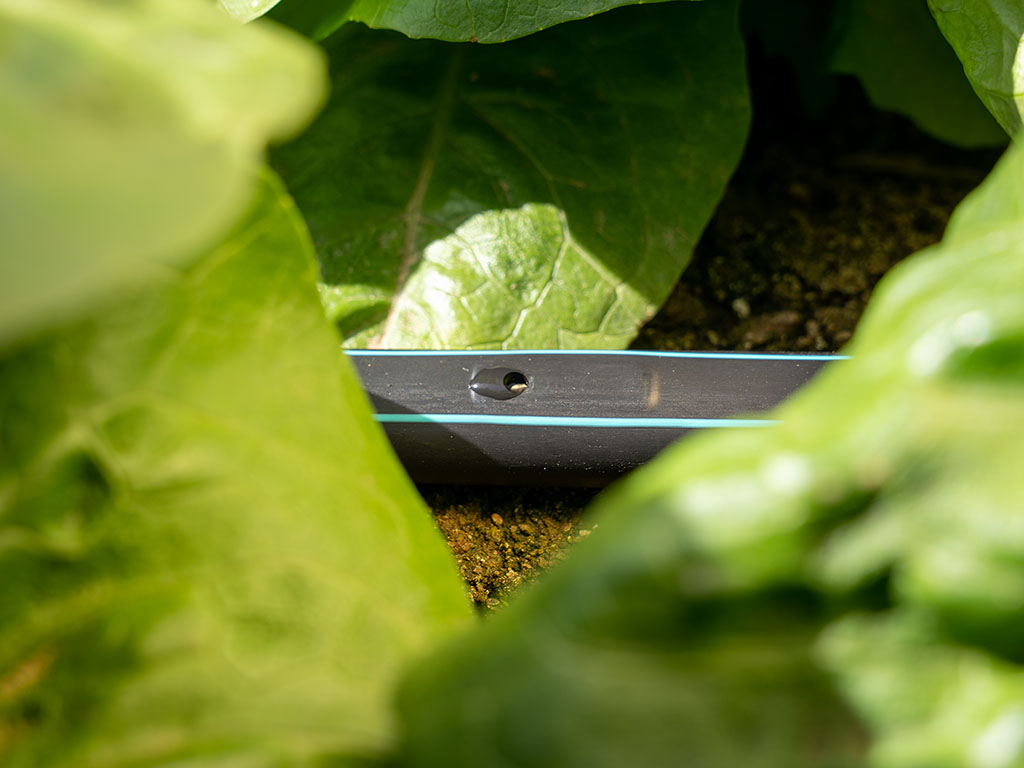
Drip irrigation is the most efficient irrigation system of all, as it delivers less water to the soil than other systems, thereby significantly reducing losses due to evaporation and percolation. This efficiency can be further improved by burying the drippers; we will discuss underground irrigation in another article. The main problem with drip irrigation systems is the blockage of the drippers, but this can be prevented.
The dripper is a device through which water flowing through the pipe emerges from the dripper itself at a specific flow rate. This flow rate varies depending on the dripper model. To achieve this, the water must be ‘slowed down’ within the dripper – in other words, its pressure must be reduced – and this is done by the labyrinth inside the dripper. However, this labyrinth is a narrow passage – the lower the flow rate of the dripper, the narrower it is – in which any particle can become lodged and block the passage of water, resulting in a reduction in the dripper’s flow rate, which can eventually lead to a complete blockage (the dripper becoming totally blocked).
To avoid this negative effect, the first factor to consider is the dripper itself. The dripper must have a good filter and an optimal labyrinth design that prevents particles from accumulating inside it. If the pipe with the dripper is buried, the dripper must be anti-suction (preventing water from entering through the dripper) and root-resistant (preventing roots from entering through the dripper’s holes). At Caudal, we stock drippers that meet these requirements. Click here to view our range of pipes with integrated anti-suction drippers.
But sometimes all this isn’t enough; let’s look at where the particles suspended in the water that block the drippers come from.
- Inorganic particles: Water quality is important, as the water often contains suspended particles that block the drippers (sand, silt, salts, etc.); for this reason, a water analysis is highly recommended. Depending on the type of water, the irrigation system will need to be fitted with a filtration unit to prevent water laden with particles from reaching the drippers. The dripper’s technical specifications should state the maximum size of suspended particles in the water that it can handle without becoming blocked. The filtration system must prevent particles larger than the specified size from passing through. We will discuss water filtration in more detail in a future article. At the end of the growing season, it is advisable to carry out a treatment with a low-concentration acid to remove calcium carbonate deposits, which often build up in the drippers when the water is hard.
- Organic particles: organic fertilisers and the biological load carried by the water (micro-organisms suspended in the water) form an explosive mixture, as they generate biofilm (micro-organisms that grow in our pipework, feeding on the organic matter we introduce); to prevent this, the best approach is to carry out preventative treatment by continuously injecting a low-concentration oxidising agent (such as hydrogen peroxide) into the irrigation system. This will prevent the biofilm from developing. If biofilm has already developed, treatment should be carried out using the same oxidising agent, but at a higher concentration. Sometimes, the dripper filter is completely clogged with biofilm and this treatment is not effective, as the water containing peroxide cannot pass through the dripper and is unable to clean it. When carrying out these strong treatments, it is advisable to open the end-of-line valves to flush out the biofilm that has come loose from the pipe walls and the drippers.
At Caudal, we have drippers designed to prevent blockages. Please get in touch with us and we’ll be happy to advise you.
Manuel Gómez Carmona
Agricultural Engineer at Caudal