


What is the almond tree? How is it grown?
The almond tree (Prunus amygdalus) is a fruit tree of the Rosaceae family, whose fruit is the almond, an edible seed that is highly prized in the food and cosmetics industries.
Benefits of growing almond trees
Almond cultivation has grown in popularity in recent years due to its high profitability and numerous benefits.
- High demand and stable prices
- Medium- and long-term profitability
- Drought resistance
- Revenue diversification
- Mechanisation and ease of harvesting
Expected yields vary significantly depending on the cultivation system. On rain-fed land with unfavourable conditions, it can range from 100 to 150 kg of seeds per hectare, whilst in well-designed and managed irrigated plantations, it can exceed 2.500–3,500 kg per hectare.
Technical Information on Cultivation
When planning an almond orchard, it is essential to take four key aspects into account. These must be analysed collectively during the design phase to ensure the crop develops optimally.
- Environmental conditions:
- The climate: the favourable climatic conditions for the healthy growth of almond trees are precisely the characteristics that define the Mediterranean climate.
- The soil: loose, well-drained soils are best, provided they contain the moisture and nutrients the plant needs.
- Selection of plant material:
Variety and pattern must be combined appropriately, so as to result in improved plant performance and more uniform, abundant and higher-quality harvests.
- Planting systems:
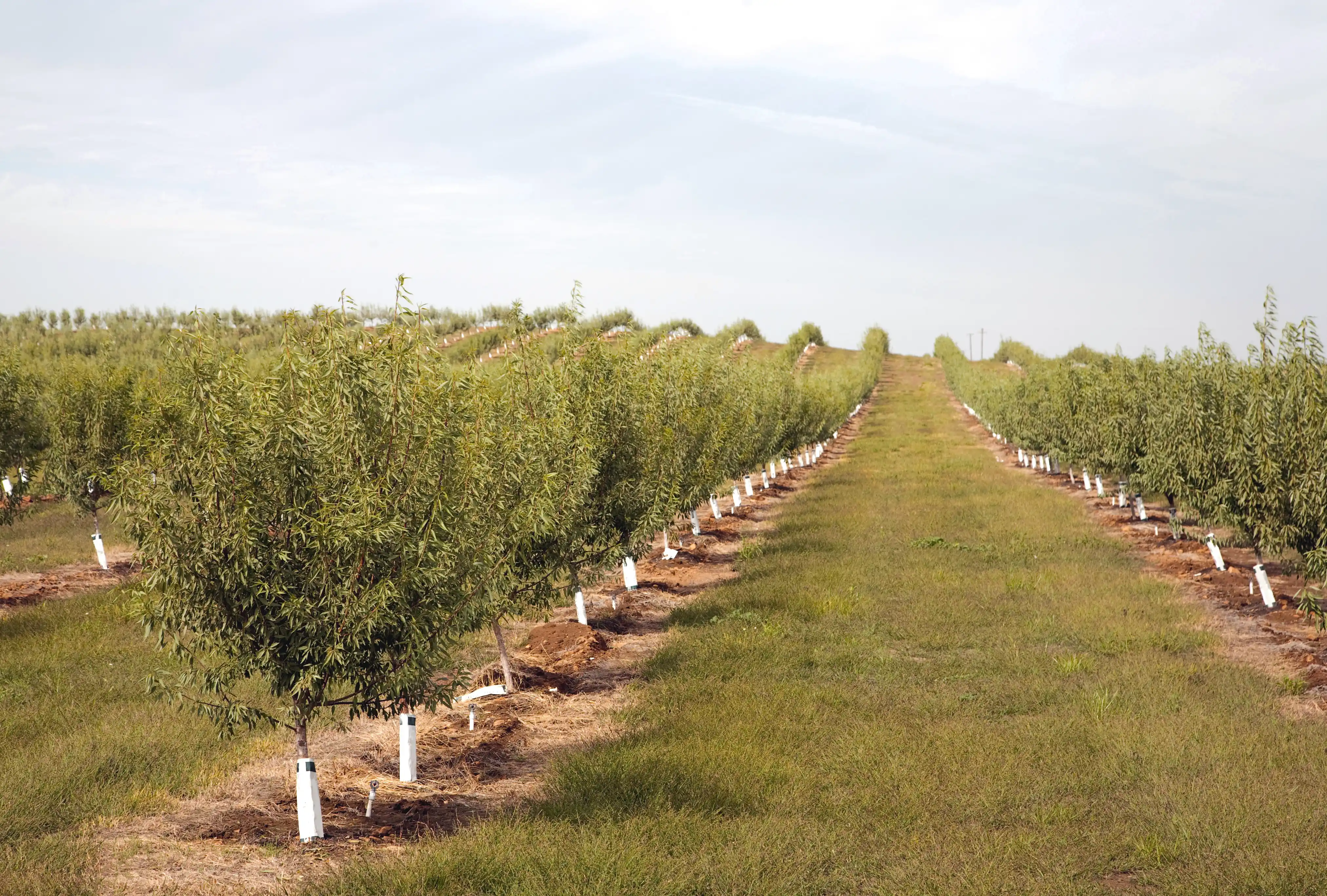
- Traditional production model: on irrigated plantations with moderate- to high-vigor varieties, planting spacings may be 7×7 m, 7×6 m or 6×6 m. If varieties of moderate vigour are used, planting spacings of 6×6 m, 6×5 m or 5×5 m may be employed. It is important to bear in mind the limiting factor of light.
- Semi-intensive model: the aims of this model are to bring forward the start of production and reduce the labour required for pruning. Planting patterns are typically 6x4m, 5x5m, 5×4.5m, 5x4m or 5×3.6m. A three-row planting pattern is recommended to optimise light uptake and space utilisation.
- Super-intensive model: the planting spacing is reduced and the tree training system is changed from a traditional bush to a central leader or fruit wall. The planting spacing used in irrigated systems, assuming a canopy height of no more than 2.7–2.9 m, has been set at 3.5 to 3 m between rows and 1 to 1.3 m between plants. This results in easier management and earlier production.
- Guidance:
The exposure of plants is determined by the slope and aspect, which affect their temperature, sunlight exposure and the energy they receive. In the northern hemisphere, the most favourable plots are those facing south, as they have the most favourable solar heat balance and therefore the greatest productive potential.

When should an almond tree be planted?
In clay-textured soils with poor drainage, root rot may occur if planting takes place before the soil reaches a temperature high enough to promote root development and growth. In such cases, it is advisable to plant in late spring.
If irrigation water is available, planting can take place in late spring or early summer. In this case, the plant’s growth period during its first year of establishment will be significantly reduced.
Soil maps for growing almond trees
It is very interesting to draw up soil maps for our future plantation for the following purposes:
- Define homogeneous irrigation management units
- To form the basis of the irrigation system design
- Identify areas with constraints
- Identify the soil moisture monitoring units
- Defining homogeneous plots to optimise production
- Minimising environmental impacts
Almond trees can achieve profitable yields when adequate irrigation, balanced fertilisation and good cultivation practices are combined.
Nowadays, in order to achieve high yields, it is particularly important to improve irrigation management. Some examples of improvements include:
- Increase in the use of drip irrigation systems
- Using soil moisture sensors for irrigation scheduling
- Building automation
- A better understanding of the influence of irrigation on aspects relating to the physiology of the almond tree
The role of irrigation in almond cultivation
Irrigation plays a vital role in ensuring good flowering, fruit set and fruit development.
Water stress (lack of irrigation) causes adverse effects at various stages of the crop’s growth:
- In the early stages of fruit development (spring), it causes the fruit to be smaller
- As the fruit approaches maturity, this causes the rind to fail to split open
- After the harvest, there is a reduction in the following year’s harvest
- Since the end of May or early June, there has been a reduction in the final weight of the harvest
- Weight loss during the ripening period
Types of irrigation in almond production
Furthermore, irrigation is essential for achieving substantial root mass and, consequently, greater foliage volume and higher yields.
As for the spacing between the drippers, it is essential to know the type of soil; we will space them 50 cm apart in sandy soils and 75 cm apart in heavier soils.
As for the flow rate of the emitters, it is advisable that these should not be too high; depending on the distance between them, they may vary between 1.6 and 2.2 l/h.
In super-intensive plantations with deep, low-fertility soils, it is advisable to install two drip lines, which we will gradually move away from the tree. In semi-intensive plantations, we will always install two lines.
Another type of drip irrigation that is also used is underground drip irrigation. The drip lines will be installed at a depth of around 20–40 cm, depending on the soil conditions, and spaced around 30 cm apart from the trees.
The advantages of underground irrigation include:
- Minimises losses due to direct evaporation
- It allows the use of effluent water
- Fewer weeds
- Lower risk of rodent bites
As for the drawbacks:
- Risk of root intrusion into the drippers
- The need to improve the design of the system to prevent suction in the drippers
- Higher installation costs
Given the importance of extremely precise irrigation, the use of soil moisture probes is vital, as it enables us to understand what is happening in the root zone of the almond tree and, consequently, to make informed decisions regarding irrigation.
The increase in the area under almond cultivation, combined with water scarcity, has led to the implementation of controlled deficit irrigation (CDI) strategies.
RDC is based on reducing irrigation during stages when the tree can tolerate drought. This means that this type of irrigation is guided by accurate information on both the crop’s phenological stage and the availability of water in the soil.
Drip irrigation solutions offered by Caudal for almond cultivation
At CAUDAL, we offer high-quality products that enable us to meet the challenges of irrigation installations in Almendro.
AENOR-certified PE100 and PE40 pipes for primary and secondary pipelines.
PC700 pipework with integrated dripper; featuring a state-of-the-art self-compensating system, a large inlet filter and wide internal bore; it offers an optimal flow rate range for almond trees, from 1.1 to 2.2 l/h. Available in pipe diameters of 16 and 20 mm and in an anti-suction (AS) version that prevents particles from entering the dripper.
For underground irrigation systems, we offer Rootguard technology, which prevents roots from penetrating the dripper, thereby ensuring the system operates perfectly.
Experience, quality and innovation make CAUDAL’s products for almond tree irrigation the ideal solution.