



What is an apricot?
The apricot is the fruit of the apricot tree, a tree belonging to the Rosaceae family. Its scientific name is Prunus armeniaca.
Where does it come from? Well, it originates from the temperate regions of Asia, such as China. The Romans brought it to Europe – believe it or not – via their trade routes with Asia, passing through Armenia. That’s where the name ‘armeniaca’ comes from. Later, between the 16th and 17th centuries, it reached the Americas from Europe.
Spain is one of the world’s leading apricot-producing countries. Average production over the last 10 years has been around 150,000 tonnes. Globally, Turkey is the largest producer, accounting for over 18 per cent of the total. Iran and Uzbekistan follow closely behind. In Europe, Italy leads the way, followed by France and Spain. In Africa, Algeria and Morocco stand out. And in the Americas, it is the United States.
Types of apricot
There are countless varieties of apricot. Here are some of the main ones:
- Búlida: This is a Spanish variety that is very hardy. It adapts to almost any type of soil. It produces a very high and consistent yield. However, it is susceptible to powdery mildew and monilia. Its fruit is large, with yellow skin and sweet, juicy flesh. It is harvested in late May.
- Canino: Another Spanish variety. The trees are very vigorous. Resistant to pests and to fruit drop. The fruits are large, round and a deep orange colour. The flesh is firm and flavourful. They are harvested in June.
- Nancy: The trees are vigorous and produce a moderate yield. The fruit is enormous, yellow with red streaks. The flesh is copper-coloured, juicy and sweet. It is harvested in June and withstands transport well.
- Paviot: Very vigorous trees. The fruit is very large, orange with a deep red colour. The flesh is yellow, very tender and fragrant. It is harvested between July and August.
- Moniquí: Moderate vigour, but production is somewhat irregular. The fruit is large, oval and pinkish-white. The flesh is juicy, sweet and very flavourful. It is harvested between June and early July. Ideal for eating straight off the table!
- Currot: This is one of the earliest varieties to reach the market. The fruits are small, with delicate skin and whitish flesh that is slightly tart. They are sometimes left to ripen before being sold, as they do not have much flavour when freshly picked.
- Galta Roja: Undoubtedly the best-selling and most widely consumed variety in Spain. It has an attractive skin, half reddish, half yellow or orange. The flesh is orange and sweet.
- Ginesta: One of the earliest-ripening varieties. Round fruit, whitish skin, white flesh, soft and delicate.
- Mitger: Notable for its size, between 50 and 55 mm. Thin, velvety skin; white, sweet and juicy flesh. They appear in late May.
There are also late-season varieties, such as those from CEBAS or IMIDA, which help to extend the season. For example, Murciana and Dorada are later-ripening than Búlida.
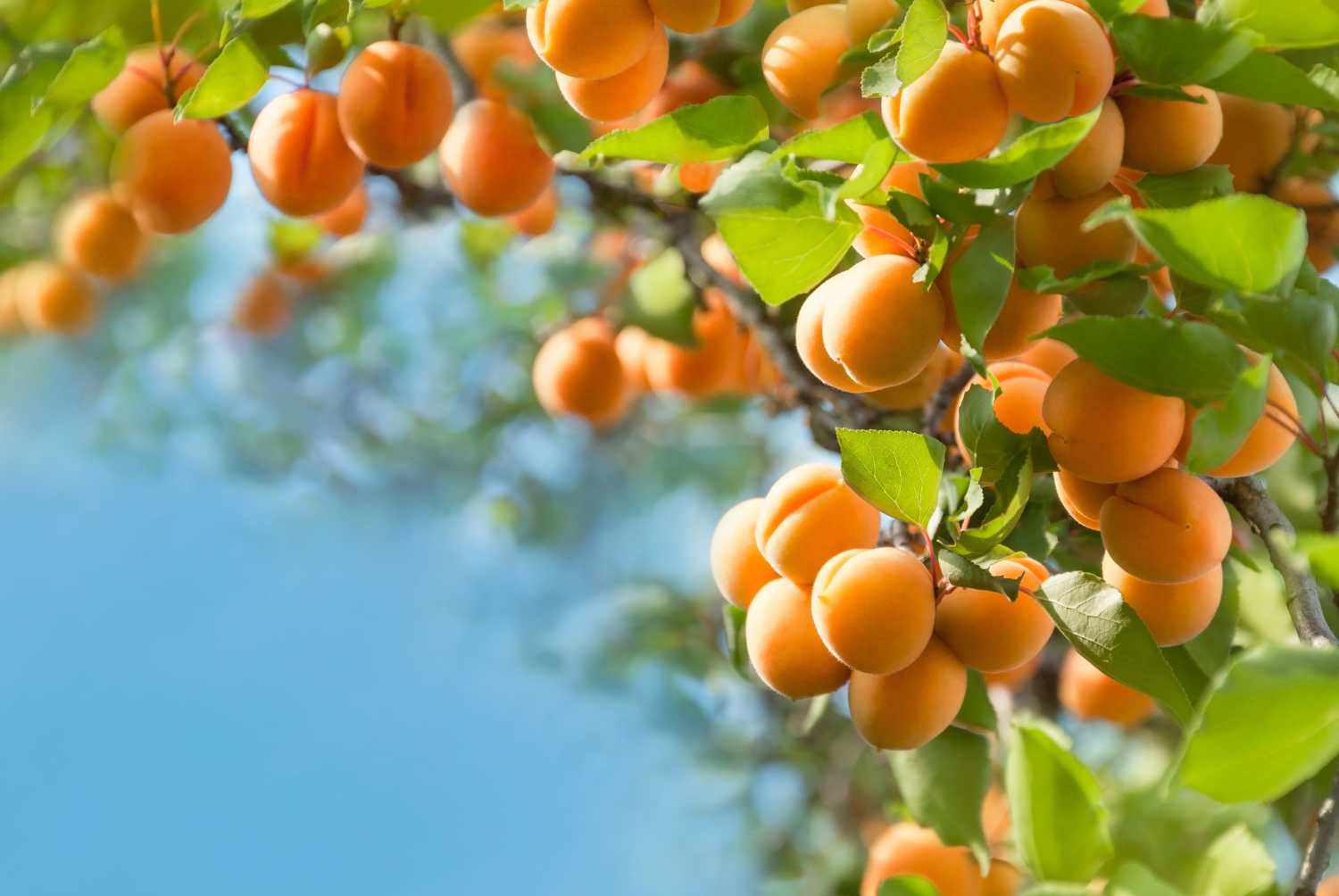
Requirements for growing apricots
The apricot tree is rather special. It needs very specific conditions to grow well and bear good fruit.
Soil requirements
As for the soil, it isn’t particularly demanding, but it does have its preferences. It likes the following types of soil:
- Warm, dry, light.
- Deep and limestone.
Watch out! It doesn’t do well at all in heavy, cold or damp soil. If the subsoil is very well-drained, all the better! That way, water doesn’t pool, which is really bad for it. It grows very well in deep soil and produces high-quality fruit. If the soil is poorer (such as on dry slopes), the tree is smaller, but the fruit tends to be more fragrant.
For example, in a project in Caravaca de la Cruz (Murcia), the soil was loam, with low electrical conductivity and low organic matter content.
Climate requirements
The apricot tree needs a period of cold weather in winter, between 300 and 900 hours at temperatures below 7°C, depending on the variety. But here’s the problem: it flowers very, very early, between March and April. Before the leaves even appear! That’s why it’s very sensitive to late frosts. A severe cold snap at that time can be disastrous.
It also needs warmth in summer for the fruit to ripen properly. And it is fairly drought-tolerant. It prefers airy, sunny areas, such as plateaus and hills, rather than flat plains. The ideal altitude is between 200 and 500 metres.
At the Caravaca de la Cruz project, the estate lies at an altitude of between 755 and 770 metres. There, they record data on temperature, rainfall and hours of sunshine, which are crucial for crop growth.
Hydrological requirements
Watering is vital, especially at the start. Immediately after planting, you need to water thoroughly. Why? To prevent air pockets from forming around the roots and to help them take root properly in the soil. During the first year, water generously until the tree is well established.
Once the roots are well established, the apricot tree does not need as much water. Only during very long periods of drought. In fact, the literature describes it as ‘undemanding in terms of water’.
On the project’s estate, they use localised irrigation – drip irrigation, in fact! Irrigation takes place from March to November. Water doses are calculated very precisely, taking into account the crop’s needs, rainfall and soil conditions. This is done to ensure maximum efficiency.
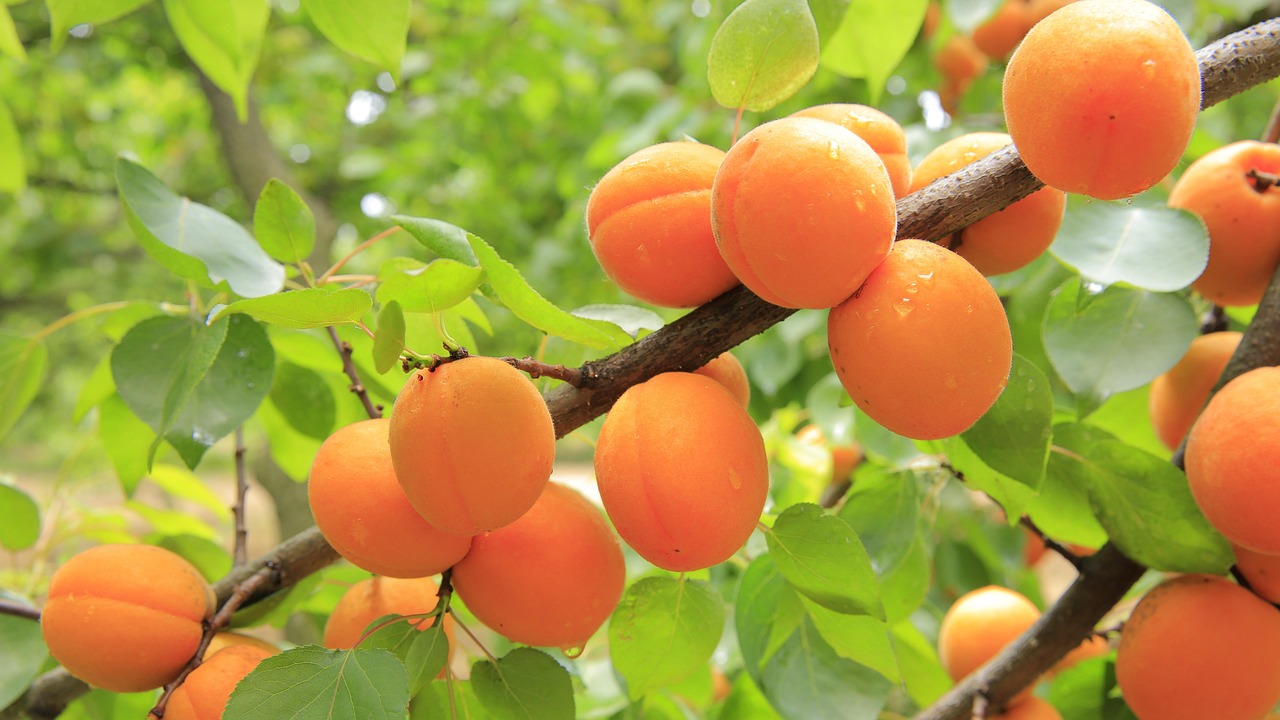
How are apricots grown?
Growing apricots involves a few steps. Let’s take a look at them!
How to sow
Before planting, you need to mark out where each tree is to go. Then, dig the holes. The distance between each tree can range from 4 to 6 metres, depending on the variety and the shape of the tree’s base.
Here’s a tip: position the plant so that the graft (the junction between the scion and the rootstock) faces the strongest winds. This will make it more resistant to breaking. Plant it at the same depth as it was in the nursery. And when filling in the hole, press the soil firmly around the trunk. Important! Do not pile any more soil on top of the trunk, as this can cause problems.
The most common way to propagate an apricot tree is by grafting, usually in spring. A rootstock of plum (such as St Julian A, Mirabolano or Reina Claudia), peach or almond is used. The almond tree, for example, is ideal for chalky, dry soils or rain-fed plantations – it has a deep root system! There are various grafting techniques, such as chip budding or shield grafting.
Before planting, the soil is prepared: deep subsoiling is carried out, stones are removed, and well-rotted manure is sometimes added to the planting rows. The planting density is usually around 370 trees per hectare, with a spacing of 6m x 4.5m.
When to sow
In the project we are analysing, they began planting the main varieties in early 2014. They then added more in 2016, 2017 and 2019.
When to water
As I was saying earlier, the first watering takes place straight after planting. Then, during the first year, you need to water quite a lot. In this project, they water from March to November, following a carefully calculated plan to ensure the water reaches exactly where and when it is needed.
Apricot processing and harvesting
Caring for an apricot tree involves protecting it and knowing when and how to harvest its fruit.
Fertilisers and fertigation
Every year, it is a good idea to analyse the leaves to find out what nutrients the trees need. In the Murcia project, various types of fertiliser were used: phosphoric acid, NPK compounds, nitrates (potassium, magnesium and calcium), humic and fulvic acids, and chelates of iron, zinc and manganese.
The fertiliser is applied efficiently via the irrigation system itself (fertigation). The quantities vary depending on the age of the tree. For example, for the ‘Búlida’ variety, part of the nitrogen is applied after harvest. For other varieties, it is applied after fruit set.
Types of pests and treatments
You really have to keep a close eye on things here! Pests and diseases can cause a lot of problems. Treatments are carried out in accordance with ‘integrated production’ guidelines. In winter, paraffin oil and copper are sometimes used if there are large numbers of insects or mites hibernating. Then, depending on the weather, we monitor for fruit flies and fungal diseases.
Some common problems are:
- Irregular yield: Sometimes they produce a lot of fruit, other times very little.
- Small size: The fruit does not grow large enough.
- Spring frosts: These can damage early varieties.
- Soil-borne diseases: Such as root asphyxia or certain fungi.
- Big-headed borer: Watch out for this one! It’s a beetle. Its larva is shaped like a nail and burrows tunnels under the bark. It can be devastating.
- Chlorotic twig dieback: This causes the tree to die.
- Sharka virus: It is the most feared virus in Europe! It spreads rapidly and causes severe damage to the fruit. It leaves spots on the leaves and rings in the fruit’s flesh, which becomes dry and hard.
To combat this, research is being carried out into treatments using natural substances known as ‘elicitors’. Examples include oxalic acid and salicylic acid. These activate the plant’s natural defences. Studies have shown that oxalic acid helped the plant to become more resistant to fungi and viruses. And salicylic acid can delay ripening. In fact, in a study involving the ‘Madison’ variety, these treatments increased fruit yield and weight by 13.8 per cent and 14.5 per cent respectively! Furthermore, they helped the fruit to remain firm for longer after harvest.
Apricot harvest
Apricots are picked when they change colour from green to yellowish-pink. It is important to harvest them whilst they are still firm. If they are too soft, they bruise easily and rot. They are picked by hand.
In the study of the ‘Madison’ variety, harvesting took place over several days in May. Apricots generally ripen in May and June, depending on the variety.
An interesting fact: if they are picked earlier, they are more resistant to transport. If they are picked later, they taste better, but do not keep as long.
Irrigation products for apricot trees
Do you want your apricot trees to thrive? At Caudal, we know that proper irrigation is the key. We specialise in efficient irrigation systems to ensure your crop grows healthily and productively.
Boost your harvest now! Take a look at our fruit tree irrigation kits.
What is the best irrigation system for apricot trees?
There’s no doubt that drip irrigation is an excellent solution.
How does drip irrigation improve crop yield?
Drip irrigation is brilliant. It ensures that water reaches the roots of each tree. Every drop is precisely controlled. This makes irrigation extremely efficient. It adapts to the plant’s needs, the climate and the type of soil.
So, not only do you save water – which is great for the planet and your pocket! – but you also contribute to more sustainable agricultural production. And by preventing excess moisture on the leaves, you reduce the risk of many diseases. What’s more, when the system is well designed, it helps the roots to establish themselves better at the start. It’s all good news!
What apricot-based products does Caudal offer?
At Caudal, we want to be your number one partner for apricot irrigation. Our aim is to provide you with practical information