



Types of watermelon:
- Black watermelon: with dark skin and very sweet flesh.
- Striped watermelon: the most common variety, with green stripes on its skin, very sweet flesh and a high yield.
- Seedless watermelons: these are parthenocarpic plants resulting from hybridisation techniques.
- Mini or baby watermelon: ideal for individual consumption. Widely grown in greenhouses.
At present, most planting is carried out using plants grafted onto pumpkin rootstock, to avoid problems with vascular and soil-borne fungi.
Watermelon is a plant that is highly sensitive to herbicides, so it is recommended to plant them in weed-free soil and to use mulch (which retains soil moisture and prevents weeds from growing) made from opaque polyethylene film of 100 to 150 galgas, with a width of 60 to 80 cm.
The global area under watermelon cultivation is around 3 million hectares, with China, Turkey and Brazil being the leading producers. In Spain, around 20.000 hectares are under cultivation, mainly in Andalusia and Murcia. The largest consumers are China and the US. In Europe, the main consumers are Spain, Italy, Germany and France. Spain is the leading supplier to the European market thanks to its favourable climate. Consumption rises significantly in summer, between June and August, due to the fruit’s refreshing qualities.
Requirements for growing watermelons
Soil requirements
Watermelons thrive in light, well-drained soil with a pH of between 6 and 7.5. High salinity prevents or hinders the plant’s growth.
Climate requirements
It is a warm-climate plant that requires temperatures above 20 °C to germinate properly. Temperatures of between 25 and 30 °C during the vegetative growth and flowering stages promote good yields. Frosts and heavy rain have a negative impact on production.
Water requirements
Watermelons require a constant supply of water, particularly during the flowering and fruit-setting stages. Growing watermelons using drip irrigation allows water to be supplied precisely and efficiently, preventing water stress and reducing losses through evaporation. Depending on whether the crop is grown in the open field or in a greenhouse, the requirements vary:
Open field:
- Total water requirement: Approximately 400 to 600 mm per cycle, depending on the climate and soil type.
- Common irrigation methods:
- Gravity irrigation (less efficient).
- Sprinkler irrigation
- Drip irrigation (more efficient and recommended).
Greenhouse:
- Total water requirement: Between 250 and 400 mm per cycle; that is, less water than in open fields because the more controlled climate reduces evapotranspiration (mainly due to reduced wind). Another factor that reduces water consumption in greenhouses is the more efficient use of drip irrigation.
- Common irrigation methods:
- Drip irrigation with automated fertigation.
- In some greenhouses, the soil is replaced by inert growing media (rock wool, perlite, coconut fibre).
How are watermelons grown?
How to sow
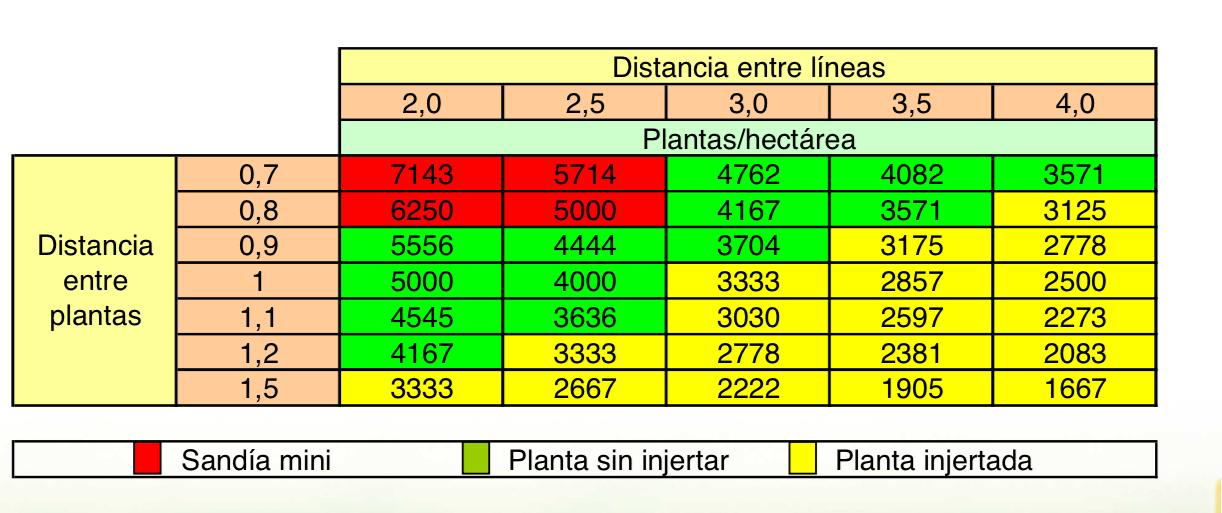
Planting can be done by direct sowing or by transplanting seedlings (the most commonly used method). Planting spacing will depend on the type of plant (grafted or ungrafted). A distance of 2 to 4 metres between rows and 0.7 to 1.5 metres between plants is recommended. The table below shows the resulting planting densities depending on the spacing chosen (Source: El Huerto, no. 61).
When to sow
Watermelons are sown in spring, always taking care to avoid frost. In Spain, sowing takes place:
- Open season: from mid-April to May.
- Greenhouse: from mid-December to March.
When to water
Drip irrigation should begin after sowing and be maintained on a regular basis. The most critical time for irrigation is during flowering and fruit development. Over-watering during the latter stage can affect sugar levels.
Open field:
- Watering frequency:
- Initial (germination and establishment): every 2–4 days.
- Vegetative growth and flowering: every 4–7 days.
- Fruit set and development: every 3–5 days (critical).
- Ripening: reduce watering to improve quality (sugar content).
Greenhouses:
- Watering frequency:
- More frequently, but with smaller amounts of water (several times a day, depending on the growing medium and the weather).
- Monitoring using soil moisture sensors and tensiometers.
Fertilisers and fertigation.
Fertilisation of watermelons must be tailored to the crop’s growth stage:
- Nitrogen: in the early stages to stimulate vegetative growth.
- Phosphorus and potassium: during flowering and fruit set to improve fruit set and quality.
The fertigation system using drip irrigation allows for precise nutrient dosing, thereby improving efficiency.
Types of pests and plant diseases.
Pests:
- Whitefly (Bemisia tabaci), which feeds on sap and also acts as a vector for dangerous viruses, such as the tomato yellow leaf curl virus.
- Aphids, particularly Aphis gossypii and Myzus persicae, also affect watermelons, causing the leaves to curl and transmitting viruses.
- Thrips, such as Frankliniella occidentalis, attack flowers and young tissue, causing deformities and transmitting viruses.
- Two-spotted spider mite (Tetranychus urticae), a mite that causes leaf discolouration and weakens the plant.
- Leaf miners (Liriomyza spp.) form visible galleries that affect the plant’s photosynthetic capacity.
- Nematodes of the genus Meloidogyne affect the roots, causing galls that hinder the absorption of water and nutrients.
- Black caterpillars or larvae of Spodoptera spp. can attack seedlings and young leaves, and even developing fruit.
- Physiological disorders.
- Fruit cracking, which occurs when there is excessive watering following periods of drought. This can be prevented by maintaining a consistent watering regime and avoiding sudden changes in moisture levels.
- Hollow heart is caused by nutritional imbalances, particularly a lack of boron, and by poor pollination. Improving pollination and ensuring a correct balance of nutrients helps to prevent it.
- Failure to set, which is linked to extreme temperatures or poor pollination. This can result in misshapen fruit or low yields. It is recommended to introduce beehives into the orchard and protect it from unsuitable temperatures.
- Sunscald occurs on fruit directly exposed to intense sunlight, causing whitish spots or dry patches on the skin. To prevent this, it is important to maintain dense foliage or protect the fruit with natural or artificial cover.
- Iron chlorosis is common in calcareous soils and manifests as yellowing of young leaves, with the veins remaining green. This can be corrected by using chelates.
- Blossom end rot is caused by a calcium deficiency. It appears as a dark spot at the base of the fruit (where the flower used to be). Prevention involves ensuring an adequate supply of calcium, consistent irrigation management and avoiding low humidity combined with high temperatures (high DPV).
The use of authorised products, integrated pest management and constant monitoring are recommended.
Harvesting watermelons
Watermelons are harvested between 75 and 100 days after sowing. Indicators of ripeness include: a change in colour at the stem end, a hollow sound when tapped, and the colour of the base (creamy yellow). However, the main indicator is the measurement of sugar content (Brix degrees) using a refractometer.
Irrigation products for watermelons
To achieve an efficient irrigation system, it is essential to have:
- Drip tape with a minimum thickness of 8 mil (0.2 mm), fitted with drippers delivering around 1 l/h and spaced 20 cm apart. This creates a moist strip in the soil that provides the necessary water for the crop. At Caudal, we have a tape with these specifications: the S200, which is widely used in the market, with millions of metres installed every year to supply water to millions of watermelons.
- Filtration system to prevent inorganic particles from clogging the drippers.
- A system for injecting an oxidising agent (hydrogen peroxide) that prevents the build-up of biofilm, which occurs when organic fertilisers are used and cause the drippers to become blocked.
- Automatic irrigation controllers.
- Pressure control valves, to prevent excessive pressure that could cause problems with the conveyor belt.
- Moisture sensors and weather stations, to help you work out when and how much to water.